

The sun sets.
Your energy keeps going.
From a single cell to a stronger grid.
Storing tomorrow’s energy today.
Energy storage,
from cell to system.
Cylindrical LFP cell technology developed in Kayseri. Modular energy storage. One engineering vision.
Cylindrical LFP cell.
The building block of energy storage.
The Arensis BESS cell is the foundation of large-scale battery projects. Lithium iron phosphate chemistry meets cylindrical architecture.
 50 Ah / 3.2 V LITHIUM IRON PHOSPHATECYLINDRICAL CELL ARCHITECTURE
From a single cell,
to an energy storage system.
Watch cells form a pack, then packs come together inside a cabinet.
Explore the technical detailsDaily energy flows.
Generation, demand and storage.
Adjust the time of day and facility load.
Explore the balance between generation, storage and consumption.


Surplus energy is stored.
Kayseri · PVGIS-SARAH3, 2005–2023 · Monthly mean hourly generation, Türkiye time · 6 MWp PV; south-facing, 30° tilt, 14% system losses · 8 MWh / 4 MW BESS; 10–95% state of charge, assumed 96% efficiency each way · Night demand is 64% of daytime demand.
Power values are hourly averages; state of charge is shown at the end of the hour. Repeating the same monthly profile balances starting and ending charge. Changing month or demand calculates a new scenario. This is not a weather forecast or a guarantee of uninterrupted supply; auxiliary consumption, ageing and grid connection limits are not modelled. Data source: European Commission PVGIS
Different applications,
a common storage platform.
Sized for your needs.
Ready for your future.
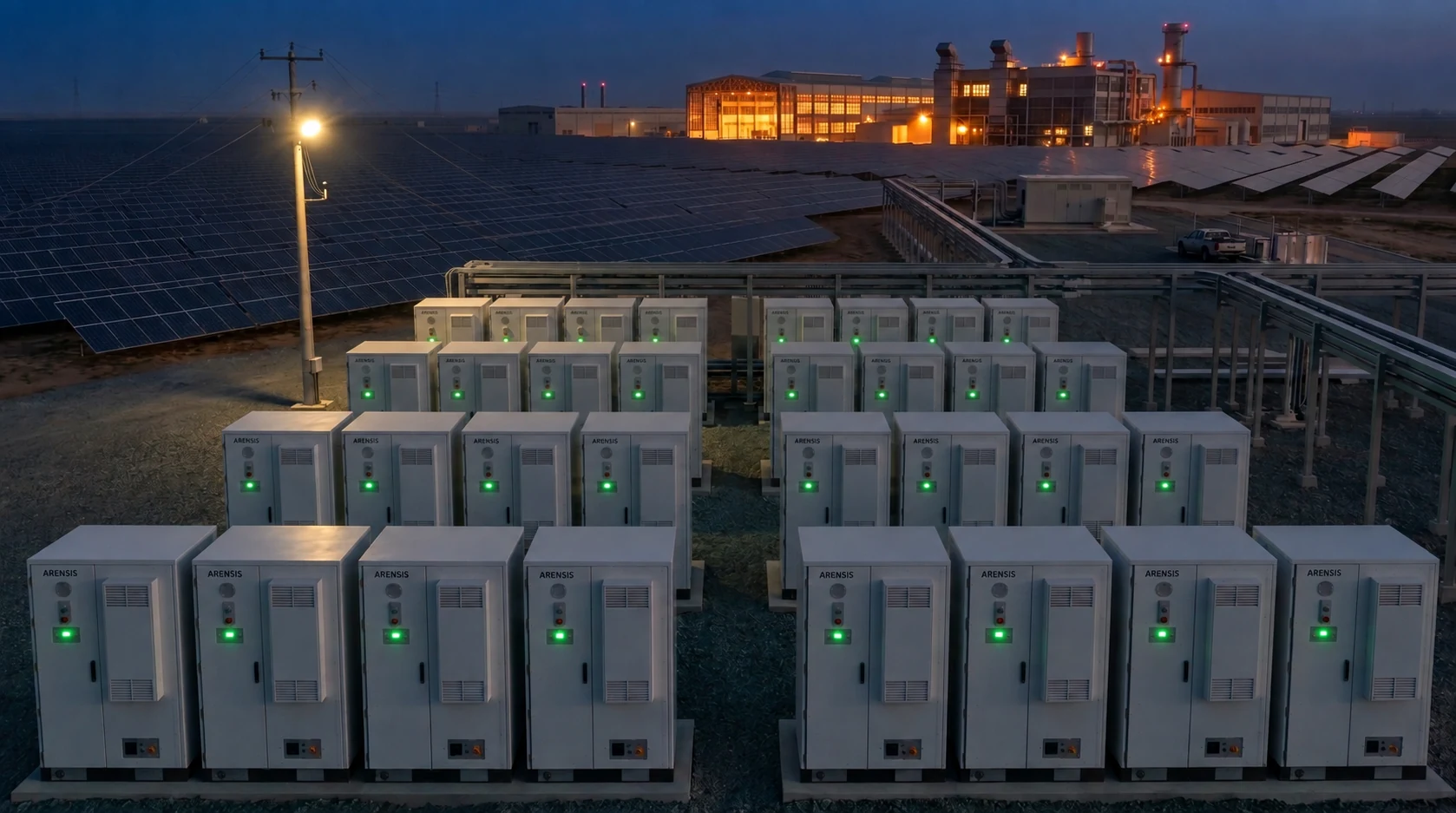
Choose your energy requirement. Let’s calculate the capacity and system scale you need with GRID BESS 50266 cabinets.

Each cabinet is rated at 266 kWh / 133 kW. Cabinet count is rounded up using a planning capacity of 250 kWh per cabinet. Groups are schematic. Operating time excludes losses and ageing; PCS selection depends on the project.
Let’s plan this system together